
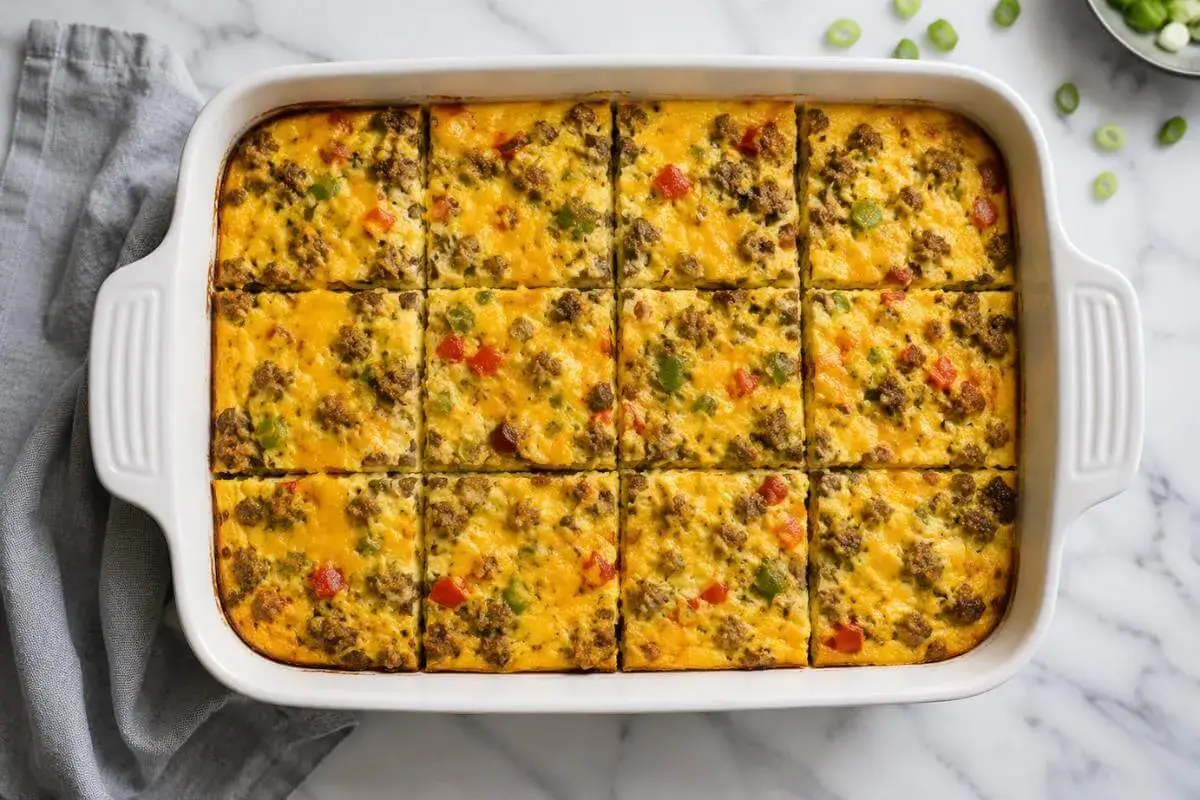
Breakfast casserole is a baked egg dish loaded with beef sausage, cheddar cheese, colorful bell peppers, and a creamy egg custard that sets into perfect, sliceable squares. With just 10 minutes of prep and one baking dish to clean, this recipe is the most practical, satisfying breakfast for a crowd you can put on the table, and it works just as well as a make-ahead breakfast casserole for Christmas morning or any busy weekend.
| Detail | Info |
|---|---|
| Prep Time | 10 minutes |
| Cook Time | 55 minutes |
| Total Time | 1 hour 5 minutes |
| Servings | 12 |
| Difficulty | Easy |
| Cuisine | American |
Table of Contents
Breakfast Casserole Recipe Contents

This is my absolute go-to recipe whenever I need to feed a crowd without spending the morning chained to a stovetop. Over the years of making this casserole, I have tested it with a handful of different egg-to-dairy ratios, and the combination of sour cream plus a splash of milk gives the final bake an incredibly rich, custardy texture that plain egg mixtures just cannot match.
My best family always asks for this one on Christmas morning, New Year’s Day, and honestly any Sunday that calls for something special. The secret that changed everything for me: drain that beef sausage grease thoroughly before adding it to the egg mixture.
Even a tablespoon of leftover fat will make the finished casserole greasy at the bottom, which ruins an otherwise outstanding dish.
My second pro tip is to mix the egg base on the lowest speed of your electric mixer, and stop the moment everything is combined.
Over-beating the eggs whips too much air in and the casserole can puff up dramatically in the oven then collapse as it cools, leaving a dense, rubbery layer. Gentle mixing means a tender, cohesive slice every time.
If you are planning this as a make-ahead casserole for a special morning, assemble everything the night before, cover the dish tightly, and refrigerate it overnight, then bake straight from the fridge with an extra 5 to 10 minutes added to the cook time.
Why This Breakfast Casserole Recipe Works Every Time
The reason this is genuinely the best breakfast casserole comes down to the egg custard base. Using sour cream instead of straight milk creates a denser, more satisfying set that slices cleanly rather than crumbling apart on the spatula. The fat in the sour cream also coats the proteins in the eggs, slowing them down slightly during baking so the casserole stays tender rather than turning rubbery at the edges while the center is still wet.
Sautéing the bell peppers and green onions separately, rather than adding them raw, makes a meaningful difference. Raw vegetables release moisture as they bake, which steams the egg mixture from the inside and can leave the center wet long after the edges are done. A quick 2-to-3-minute sauté drives off that excess moisture and lets the vegetables pick up a little color, which deepens the overall savory flavor of the finished dish. If you enjoy other hearty baked casserole dinners, you already know that properly prepared vegetables are always what separates a good bake from a great one.
Finally, the 2 pounds of beef sausage is not excessive for 12 servings. Each square of this savory breakfast casserole contains a full, satisfying portion of protein, which means this dish genuinely holds people over until lunch. There are no filler ingredients, no bread base, and no potato layer competing for space. Every bite delivers beef, egg, cheese, and vegetable in the right proportion.
The Best Breakfast Casserole Ingredients
| Ingredient | Quantity | Notes and Alternatives |
|---|---|---|
| Beef sausage | 2 pounds (900g) | Use ground beef sausage, sliced beef kielbasa, or turkey sausage for a leaner option |
| Eggs | 12 large | Large eggs work best; medium eggs will produce a slightly thinner custard |
| Sour cream | 1 cup (240g) | Light or full-fat both work; full-fat gives a richer result. Plain Greek yogurt is a reliable substitute |
| Milk | 1/4 cup (60ml) | Whole milk preferred; 2% works fine. Unsweetened oat milk for a dairy-reduced version |
| Kosher salt | 1 teaspoon | Reduce to 3/4 tsp if your sausage is heavily seasoned |
| Ground black pepper | 1/2 teaspoon | Freshly cracked preferred for a stronger flavor |
| Green onions | 4 stalks | White and light green parts sliced thin; substitute 1/4 cup diced yellow onion |
| Green bell pepper | 1/2 medium, diced | Any color works; orange or yellow bell pepper adds a milder, sweeter note |
| Red bell pepper | 1/2 medium, diced | Adds color and a touch of sweetness; jarred roasted red pepper works in a pinch |
| Shredded cheddar cheese | 2 cups (200g) | Sharp cheddar gives the most flavor; Colby-Jack or Monterey Jack are milder alternatives |
Mise en Place and Prep Steps
- Preheat the oven to 350°F (175°C) so it reaches full temperature before the casserole goes in.
- Spray a 9×13-inch baking dish generously with cooking spray and set it on the counter within reach.
- Dice the green and red bell peppers into roughly 1/2-inch pieces and place them in a small bowl together.
- Slice the green onions thin, both the white and light green parts, and add them to the bowl with the bell peppers.
- Measure out the sour cream and milk and place them beside the mixing bowl.
- Shred the cheddar cheese if starting from a block, or measure pre-shredded cheese. Set aside 1/4 cup to sprinkle on top if desired.
- Crack all 12 eggs into the large mixing bowl, checking for shell fragments, and set the bowl aside ready for mixing.

How To Make Breakfast Casserole Step-by-Step
Step 1: Build the Egg Base
- Add eggs, sour cream, milk, shredded cheddar cheese, salt, and pepper to a large mixing bowl.
- Mix on low speed with electric hand mixers for 15 to 20 seconds, stopping the moment the mixture is combined and uniform. Do not overmix.
Step 2: Cook the Sausage
- Heat a large skillet over medium heat until the pan is hot but not smoking.
- Add the beef sausage and cook for 7 to 9 minutes, breaking it into small crumbles with a wooden spoon as it browns.
- Drain the skillet thoroughly, leaving just a very thin film of fat in the pan, and transfer the cooked sausage into the egg mixture bowl.
Step 3: Sauté the Vegetables
- Return the skillet to medium heat. Add the diced bell peppers and sliced green onions directly to the pan without adding any oil.
- Sauté for 2 to 3 minutes, stirring occasionally, until the vegetables are slightly softened and any surface moisture has cooked off.
- Transfer the sautéed vegetables into the bowl with the egg and sausage mixture.
Step 4: Assemble and Bake
- Stir the entire mixture together with a large spoon until the sausage and vegetables are evenly distributed throughout the egg base.
- Pour the mixture into the prepared 9×13-inch baking dish, spreading it to the corners.
- Bake on the center oven rack for 35 to 50 minutes, checking at the 35-minute mark. The casserole is done when the edges are fully set and the center has only a slight jiggle when the pan is gently nudged.
- Remove from the oven and allow to rest for 5 minutes before slicing into 12 squares and serving.

Breakfast Casserole with Eggs, Sausage and Cheese
- Total Time: 1 hour 5 minutes
- Yield: 12 servings 1x
Description
This Breakfast Casserole is a reliable, crowd-pleasing bake loaded with beef sausage, eggs, colorful bell peppers, and melted cheddar cheese. It comes together in just 10 minutes of prep and bakes into a golden, sliceable dish that feeds 12 people with ease. Whether you need a make-ahead breakfast casserole for Christmas morning or a savory weekend brunch, this is the recipe you will reach for every time.
Ingredients
- 2 pounds beef sausage
- 12 eggs
- 1 cup sour cream (light or regular), 240g
- 1/4 cup milk, 60ml
- 1 teaspoon kosher salt
- 1/2 teaspoon ground black pepper
- 4 green onions, sliced
- 1/2 green bell pepper, diced
- 1/2 red bell pepper, diced
- 2 cups shredded cheddar cheese, 200g
Instructions
- Preheat and Prep the Pan: Preheat oven to 350°F (175°C). Spray a 9×13-inch baking pan with cooking spray and set aside.
- Mix the Egg Base: Combine eggs, sour cream, milk, shredded cheddar cheese, salt, and pepper in a large bowl. Mix on low speed with electric mixers just until combined; do not overmix.
- Cook the Beef Sausage: Heat a large skillet over medium heat. Add beef sausage and cook until browned, breaking it into small crumbles with a wooden spoon. Drain most of the grease, then add sausage to the egg mixture bowl.
- Sauté the Vegetables: In the same skillet, sauté the diced bell peppers and green onions for 2 to 3 minutes until just softened. Add to the bowl with the eggs and sausage.
- Combine and Pour: Stir everything together until evenly distributed. Pour the mixture into the prepared 9×13-inch pan.
- Bake: Bake for 35 to 50 minutes, or until the edges are fully set and the center has only the slightest jiggle when you gently shake the pan.
- Rest and Slice: Allow the casserole to rest for 5 minutes before slicing into squares and serving.
Notes
For the best texture, do not overmix the egg base, low speed for just a few seconds is enough. Drain the sausage grease thoroughly so the casserole does not turn out greasy. You can assemble this the night before, cover tightly with plastic wrap, refrigerate overnight, and bake straight from the fridge the next morning, adding 5 to 10 minutes to the bake time.
- Prep Time: 10 minutes
- Cook Time: 55 minutes
- Category: Breakfast
- Method: Baking
- Cuisine: American
Nutrition
- Serving Size: 1 square (1/12th of dish)
- Calories: 385
- Sugar: 1g
- Sodium: 669mg
- Fat: 30g
- Saturated Fat: 12g
- Unsaturated Fat: 16g
- Trans Fat: 0g
- Carbohydrates: 2g
- Fiber: 0g
- Protein: 23g
- Cholesterol: 239mg
Keywords: breakfast casserole, make ahead breakfast casserole, savory breakfast casserole, breakfast for a crowd, best breakfast casserole
Chef Tips for a Perfect Breakfast Casserole
- Drain the sausage thoroughly. Excess grease pooling at the bottom of the dish is the single most common reason a savory breakfast casserole turns out greasy and dense. After browning, tip the skillet and spoon out the fat, or transfer the sausage to a plate lined with paper towels for 60 seconds before adding it to the eggs.
- Mix the egg base on low, briefly. Stop the mixer the moment you see a uniform, pale yellow mixture. Overworked eggs trap too much air, causing the casserole to puff dramatically then fall and turn rubbery as it cools.
- Check for doneness with a gentle shake, not a knife. Insert a knife only if you are unsure, a clean pull with a slight custardy coating is exactly right. A completely dry knife often means the casserole has gone 5 to 8 minutes past its ideal point.
- Use a metal or ceramic pan, not glass. Glass baking dishes conduct heat unevenly and can leave the bottom of the casserole pale and underdone while the top browns. A ceramic or light metal 9×13 pan gives a more even, golden result.
- Finish with a cheese sprinkle in the last 10 minutes. For a deeper, more attractive cheddar crust on top, hold back 1/4 cup of the shredded cheese and scatter it over the casserole at the 30-minute mark. It will melt and brown into a beautiful golden layer.
- Let it rest before cutting. The egg custard continues to set for the first 4 to 5 minutes out of the oven. Cutting immediately causes the squares to fall apart and lose their shape on the plate.
Common Mistakes to Avoid When Making Breakfast Casserole
| Mistake | Why It Happens | How to Fix It |
|---|---|---|
| Wet, soggy center | Raw vegetables release moisture during baking, creating steam pockets inside the custard | Always sauté vegetables for 2 to 3 minutes before adding to the egg base to drive off excess moisture |
| Greasy bottom layer | Insufficient draining of the sausage grease after browning | Drain the skillet completely after cooking the sausage, blotting with paper towels if needed |
| Rubbery, dense texture | Overmixing the egg base incorporates too much air, which collapses during baking | Mix on the lowest speed for no more than 20 seconds and stop immediately when combined |
| Uneven bake (edges set, center still liquid) | Oven temperature too high or casserole placed on the top rack | Always bake on the center rack at exactly 350°F and start checking at the 35-minute mark |
| Casserole falls apart when sliced | Cutting immediately after removing from the oven before the custard finishes setting | Rest the casserole uncovered on the counter for a full 5 minutes before slicing |
Variations and Substitutions for Every Breakfast Casserole Idea
One of the greatest strengths of this recipe is how easily it adapts to different tastes and dietary needs. These are the tested substitutions that work without changing the baking time or the overall structure of the dish. If you love experimenting with baked casserole dishes with bold flavors, this framework opens up a huge range of breakfast casserole ideas.
| Ingredient | Substitution | Impact on Flavor |
|---|---|---|
| Beef sausage | Turkey sausage or chicken sausage | Leaner, slightly milder flavor with the same savory profile |
| Sour cream | Plain full-fat Greek yogurt | Slightly tangier and higher in protein; texture is nearly identical |
| Cheddar cheese | Colby-Jack or Pepper Jack | Milder or spicier depending on the choice; both melt well |
| Bell peppers | Diced zucchini or mushrooms | Earthier flavor; mushrooms add an umami depth that complements the beef sausage |
| Whole milk | Unsweetened oat milk or almond milk | Slightly thinner custard; flavor difference is minimal after baking |
| Green onions | 1/4 cup diced yellow onion, sautéed | Stronger, more pronounced onion flavor throughout the dish |
Serving Suggestions and Pairings for a Crowd
This breakfast casserole is a complete meal on its own, but pairing it thoughtfully turns a simple breakfast into a full spread. For a Christmas morning breakfast for a crowd, serve squares alongside a fruit salad of fresh berries, sliced melon, and citrus segments to balance the richness of the egg and cheese. A side of warm, buttered toast or sliced crusty bread lets guests mop up any extra egg from the plate.
For a weekend brunch setting, add a simple green salad dressed with a light vinaigrette and a pot of good coffee. The casserole also pairs well with roasted tomatoes or a side of sautéed mushrooms for guests who want more vegetables on the plate. If you are building a larger brunch menu, this dish works beautifully next to a tater tot casserole for guests who want a starchier side.
For holiday occasions specifically, slice the casserole into smaller 2-inch squares and serve as part of a buffet table. Guests can take one or two pieces alongside other dishes, which means a single 9×13 pan can stretch to feed 16 to 18 people in a buffet format.
Storage and Reheating Instructions
| Method | Duration | Instructions | Ready Indicator |
|---|---|---|---|
| Refrigerator storage | Up to 4 days | Cool completely, cover the dish tightly with plastic wrap or transfer to an airtight container | No sour or off smell; egg texture still firm and intact |
| Freezer storage | Up to 2 months | Slice into individual portions, wrap each in plastic wrap, place in a zip-top freezer bag | No ice crystals inside the egg; slices should look the same as when frozen |
| Microwave reheating | 60 to 90 seconds | Place one square on a microwave-safe plate, cover loosely, heat on medium power | Warm through to the center; cheese melted and steaming slightly |
| Oven reheating | 12 to 15 minutes at 325°F | Place portions in a baking dish, cover with foil, reheat from refrigerator temperature | Internal temperature reaches 165°F; edges are warm and cheese is re-melted |
| Overnight make-ahead (unbaked) | Up to 12 hours in fridge | Assemble the full casserole, cover tightly with plastic wrap, refrigerate overnight | Bake the next morning at 350°F; add 5 to 10 minutes to the standard bake time |
Nutritional Information
Approximate values per serving (1 of 12 squares).
| Nutrient | Amount per Serving |
|---|---|
| Calories | 385 kcal |
| Carbohydrates | 2g |
| Protein | 23g |
| Total Fat | 30g |
| Saturated Fat | 12g |
| Cholesterol | 239mg |
| Sodium | 669mg |
| Potassium | 327mg |
| Sugar | 1g |
| Vitamin A | 705 IU |
| Vitamin C | 11.6mg |
| Calcium | 194mg |
| Iron | 1.8mg |
Easy Breakfast Casserole Recipe
This breakfast casserole brings together beef sausage, a golden egg custard, colorful bell peppers, and sharp cheddar into one reliable, crowd-ready bake that works for any occasion.
Whether you build it the night before as a make-ahead breakfast casserole for Christmas morning or throw it together on a Saturday with whatever is in the fridge, every square delivers the same bold, savory flavor and satisfying texture. Make it once and it will become your go-to breakfast for a crowd.
Follow me on PINTEREST and X/twitter for all of my latest blog posts, videos, and recipes.

FAQs About Breakfast Casserole
What is the best breakfast casserole?
The best breakfast casserole is one built on a properly proportioned egg custard base, eggs mixed with sour cream or cream, combined with a well-seasoned protein and at least one fresh vegetable. This recipe earns its reputation as the best breakfast casserole because it uses 2 pounds of beef sausage across 12 servings, a sour cream custard that stays rich without being heavy, and a fully sautéed vegetable base that prevents sogginess. The result is a dish with real structure, deep savory flavor, and a texture that holds up whether you serve it fresh from the oven or reheated from the fridge the next day.
What is Dolly Parton's five-ingredient casserole?
Dolly Parton's five-ingredient casserole is a simple, minimal baked dish that typically combines eggs, canned biscuit dough, sausage, cheese, and a dairy element like milk or cream of mushroom soup. It is well-known for being an extremely quick assembly recipe with almost no prep work. While that version leans on convenience ingredients, this recipe takes a slightly more hands-on approach by browning fresh beef sausage and sautéing real vegetables, which produces a noticeably more flavorful and satisfying result with a cleaner ingredient list.
What are some common mistakes to avoid when making breakfast casseroles?
The most common mistake is adding raw vegetables directly to the egg base without cooking them first, which causes excess moisture to release during baking and leaves the center wet and undercooked. Skipping the sausage draining step is the second biggest issue, producing a greasy, heavy bottom layer. Overmixing the egg base and cutting the casserole immediately after it comes out of the oven are two additional mistakes that damage the texture and structure of the final dish. Each of these issues is easy to avoid with the steps and timing outlined in this recipe.
What is an Amish breakfast casserole?
An Amish breakfast casserole is a traditional baked egg dish that typically includes layers of sliced bread or hash browns at the base, topped with eggs, cheese, and a cured or smoked meat. The Amish version is known for being extremely hearty and often uses sharp cheddar in generous quantities alongside cream-heavy egg mixtures. This recipe is a close relation in spirit, delivering that same all-in-one satisfying quality with a simplified ingredient list, no bread base, and beef sausage instead of cured varieties, making it a reliable everyday breakfast casserole as well as a holiday centerpiece.
Can I make this breakfast casserole the night before?
Yes, this is one of the best make-ahead breakfast casserole recipes available precisely because it holds overnight without any quality loss. Assemble the entire dish, cover the pan tightly with plastic wrap, and refrigerate for up to 12 hours before baking. Pull the dish out of the fridge while the oven preheats, then bake as directed, adding 5 to 10 minutes to the cook time since the mixture starts cold. This method is especially practical for holiday mornings when oven time is limited and you need multiple dishes ready close together.
Can I substitute the sour cream in this breakfast casserole?
Plain full-fat Greek yogurt is the most reliable substitute for sour cream in this breakfast casserole and produces a nearly identical texture with a slightly tangier flavor. Cottage cheese blended smooth is another option and adds extra protein per serving, though it creates a marginally softer custard. Cream cheese softened and whisked in at a ratio of 1/2 cup works as well, producing a richer, denser result. Avoid low-fat or fat-free versions of any of these substitutes, as reduced-fat dairy tends to release more water during baking and can make the egg custard watery around the edges.